
How to Set Up Unattended Remote Access on Windows
What good is remote access if your PC is asleep, signed out, or stuck behind a restart the moment you need it? Unattended remote access means connecting to a computer with nobody sitting in front of it to click Allow, and honestly, the software is the easy part. The hard part is the PC itself: it has to stay on, come back after a restart, and stay locked down while you're gone. Get those right before you leave, and the connection works when you need it instead of failing at the worst possible time.
What is unattended remote access?
There are two kinds of remote access, and the difference is who's at the other end. Attended access is the help-desk kind: someone sits at the PC, reads you a code, and clicks Allow when you connect. Microsoft's Quick Assist works exactly this way, with the person at the PC entering a security code and approving the session (Microsoft Learn). That's great for fixing a parent's laptop while they're on the phone with you.
Unattended access is the other kind. You set the PC up once, give it a password, and after that you can connect whenever you want, whether the desk is empty or you're three time zones away. This shows how the real work moves from the moment you connect to the moment you set things up: if the PC isn't ready when you leave, nobody will be there to fix it for you.
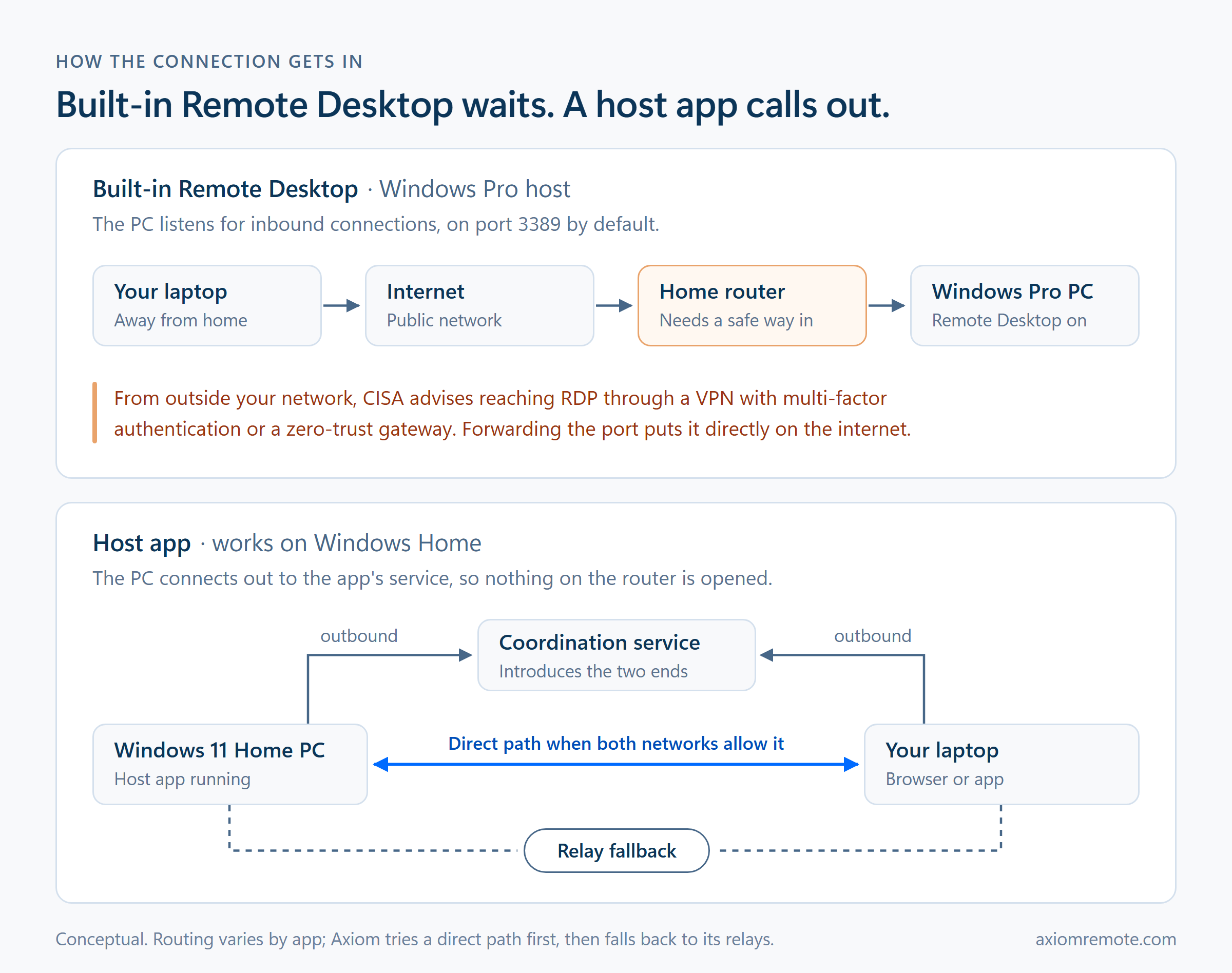
Nearly every unattended setup works the same way underneath. A small host app runs on the PC you want to reach, and you connect to it from another device with an ID and a password. Chrome Remote Desktop does it with a PIN, Microsoft's Remote Desktop does it on Pro editions of Windows (Home can't host it, which we cover in Remote Desktop on Windows 11 Home), and dedicated tools like Axiom do it with a short connect ID. The tool you pick matters less than the four checks below.
Step 1: Keep the PC awake
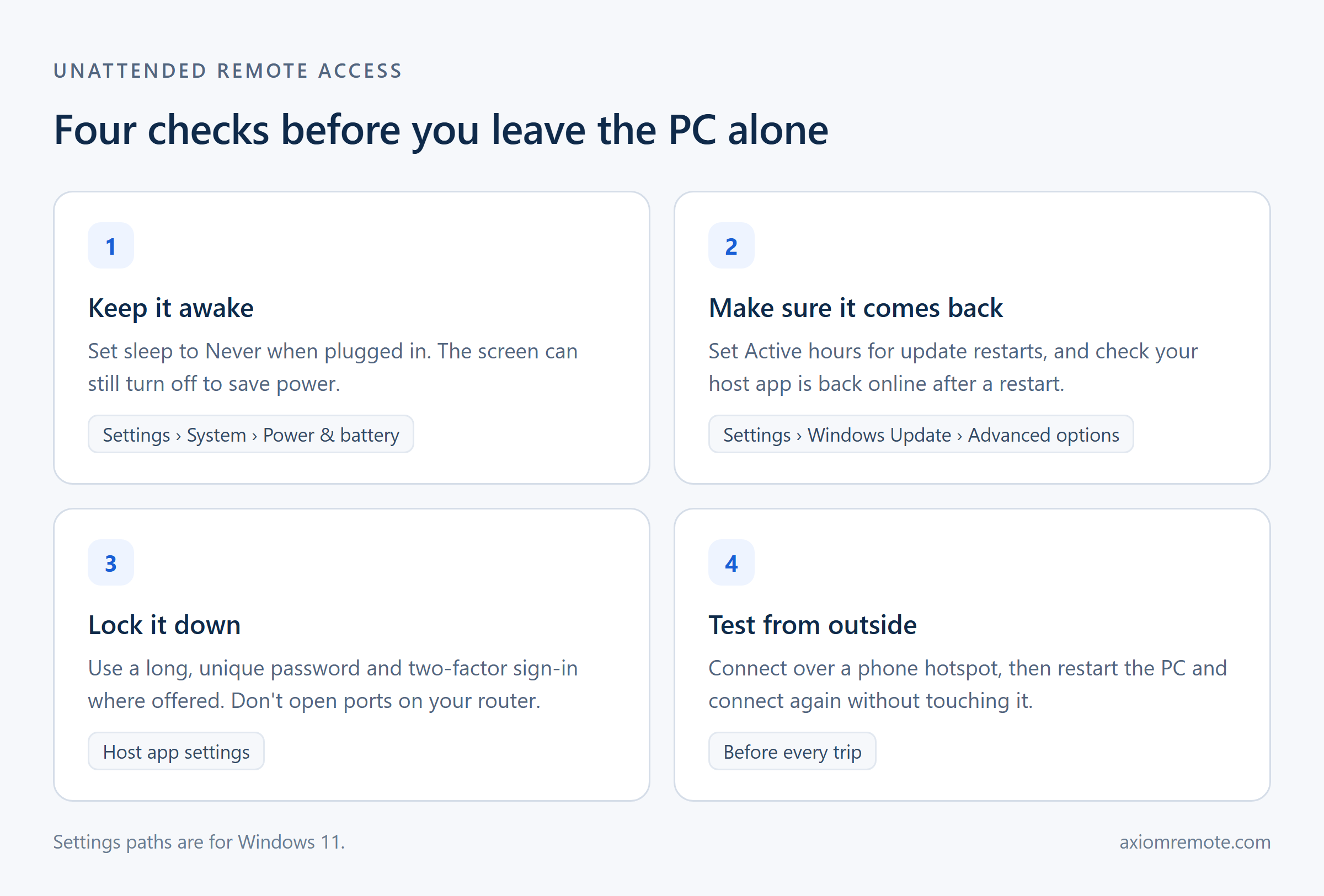
A sleeping PC is an unreachable PC, because the host app stops running the moment Windows goes to sleep. On Windows 11, open Settings, then System, then Power & battery, and under Screen, sleep, & hibernate timeouts, set the option for putting the device to sleep when plugged in to Never (Microsoft Support). Letting the screen turn off is fine, and it saves power, but sleep has to stay off.
If leaving a desktop on all day bothers you, Wake-on-LAN is the middle ground: the PC sleeps, and a special network message wakes it up before you connect. It works, but it has its own setup and its own catches, which we walk through in the Wake-on-LAN guide. For most people, the simplest reliable answer is a desktop that never sleeps with a screen that turns itself off.
One more setting lives in your motherboard's firmware rather than in Windows. Many boards have an option, usually called something like Restore on AC power loss, that turns the PC back on after a power cut. Without it, a flicker at home while you're away becomes a PC that stays off until someone presses the button.
Step 2: Make sure it comes back after a restart
Windows restarts itself for updates, and that's where a lot of unattended setups quietly fail. You can steer when it happens: open Settings, then Windows Update, then Advanced options, and set Active hours so restarts land outside the hours you'll need the PC (Microsoft Support). Don't turn updates off to dodge restarts. A PC that's reachable from anywhere is exactly the PC that needs its security patches.
The bigger question is what happens after the restart. Some host apps run as a Windows service and come back online at the sign-in screen. Others only start once someone signs in to Windows, which means a restart leaves the PC offline until a person types a password. Check which kind yours is before you trust it for a week away.
Axiom is currently the second kind, and I'd rather say that plainly than have you find out from a hotel room. Today, Axiom's host runs inside your signed-in Windows session, so the PC has to be signed in for you to reach it, and Windows administrator prompts that appear on the secure desktop aren't visible in a session yet. A version that runs as a background service and stays online at the sign-in screen is in progress. Until then, the workaround is automatic sign-in: Microsoft's free Autologon tool signs a user in when Windows starts. It's a real trade-off, though. Microsoft notes that anyone with administrator rights on that PC can retrieve the saved password, and anyone who can physically reach the machine gets a signed-in desktop, so only use it on a PC at home that you control.
Step 3: Lock it down
A PC you can reach from anywhere is a PC someone else will try to reach too, which is why the password is the whole front door. Give the host a long, unique password that you don't use anywhere else, and turn on two-factor sign-in for the account behind your remote access tool if it offers one. Keep Windows and the host app updated, for the same reason you shouldn't skip restarts.
The most important security decision is one you make by not doing something: don't open a port on your router to make the PC reachable. Forwarding a port puts a service on the open internet for anyone to find, and CISA's advice for Remote Desktop specifically is to reach it through a VPN with multi-factor authentication or a zero-trust gateway rather than exposing it directly (CISA). Host apps that connect out to their own service avoid the problem entirely, because nothing on your network waits for strangers to knock. We go deeper on this in why port forwarding is a risk.
Step 4: Test it before you leave
The only test that counts is a real one from outside your home. Before a trip, connect a laptop to your phone's hotspot and reach your PC from there. That checks the whole path at once: the host is running, the password works, and the connection gets through a network that isn't yours. If your internet provider uses carrier-grade NAT, this is also where you'll find out whether your tool can still connect.
Then test the failure you're most worried about. Restart the PC and check that you can reach it again without touching it. Leave it alone for longer than its old sleep timer and try again. Every problem you find at home is a problem you don't find from an airport.
What this looks like with Axiom
You install Axiom's host on the Windows PC, and it gets a short numeric connect ID. From any modern browser, you enter that ID and the access password, and the device in your hands doesn't need an app. Axiom tries a direct connection first and falls back to its relay servers when a network blocks the direct path, so there's no port forwarding or router setup involved, and sessions are encrypted either way.
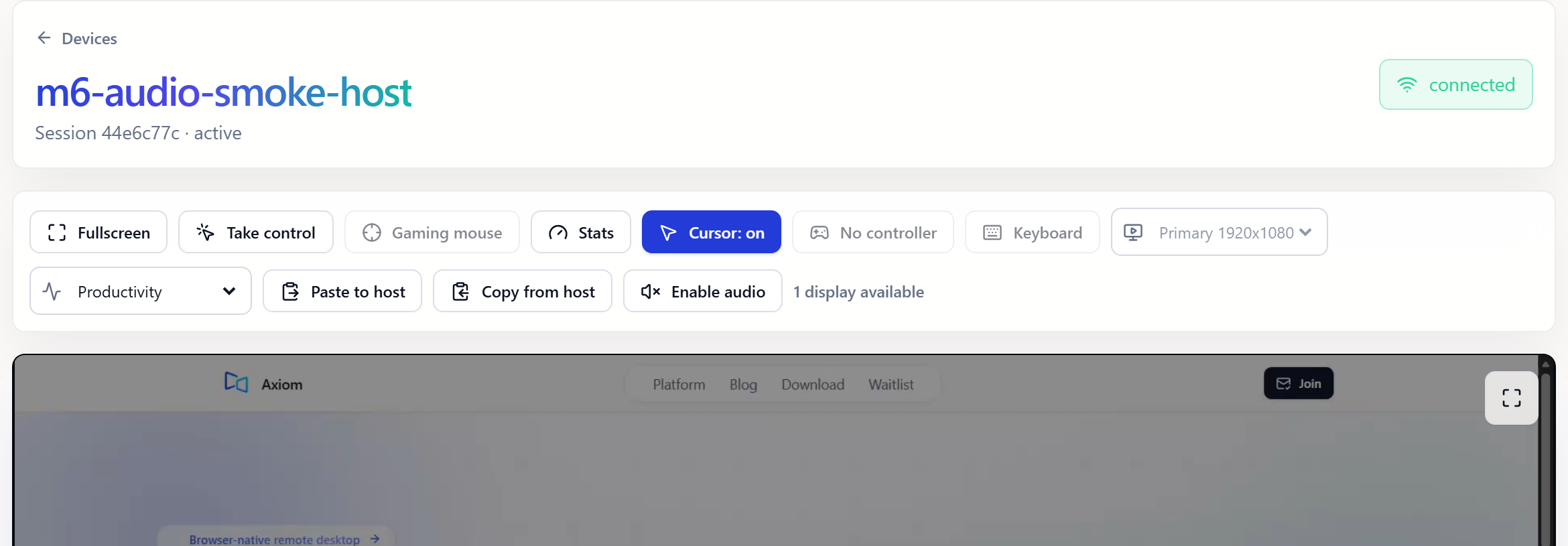
The capture below is a real Axiom session in a browser, with the controls you'd use once you're in: take control, clipboard, audio, stats, and display selection. Keep the two honest catches in mind, the sign-in requirement from step 2 and the fact that Axiom is in invite-only early access, and set it up well before the trip you need it for. Unattended access isn't really about the software you pick. It's about leaving behind a PC that's ready for you.
Common questions
What is the difference between attended and unattended remote access?
Attended access needs someone at the PC to approve each session, the way Quick Assist works. Unattended access is set up once with a password, so you can connect when nobody is there.
Do I need Windows Pro for unattended remote access?
Only for Microsoft's built-in Remote Desktop, which needs Pro or Enterprise on the PC you connect to. Host apps such as Chrome Remote Desktop or Axiom run on Windows Home too.
Why can't I reach my PC after it restarts?
Usually it's asleep, or your host app only runs after someone signs in to Windows. Check your sleep settings and whether your tool runs as a service. With Axiom today, the PC needs to be signed in.
Do I need to set up port forwarding for unattended access?
Not with host apps that connect out to their own service, such as Chrome Remote Desktop or Axiom. Exposing Remote Desktop through a forwarded port is exactly what CISA's guidance warns against.